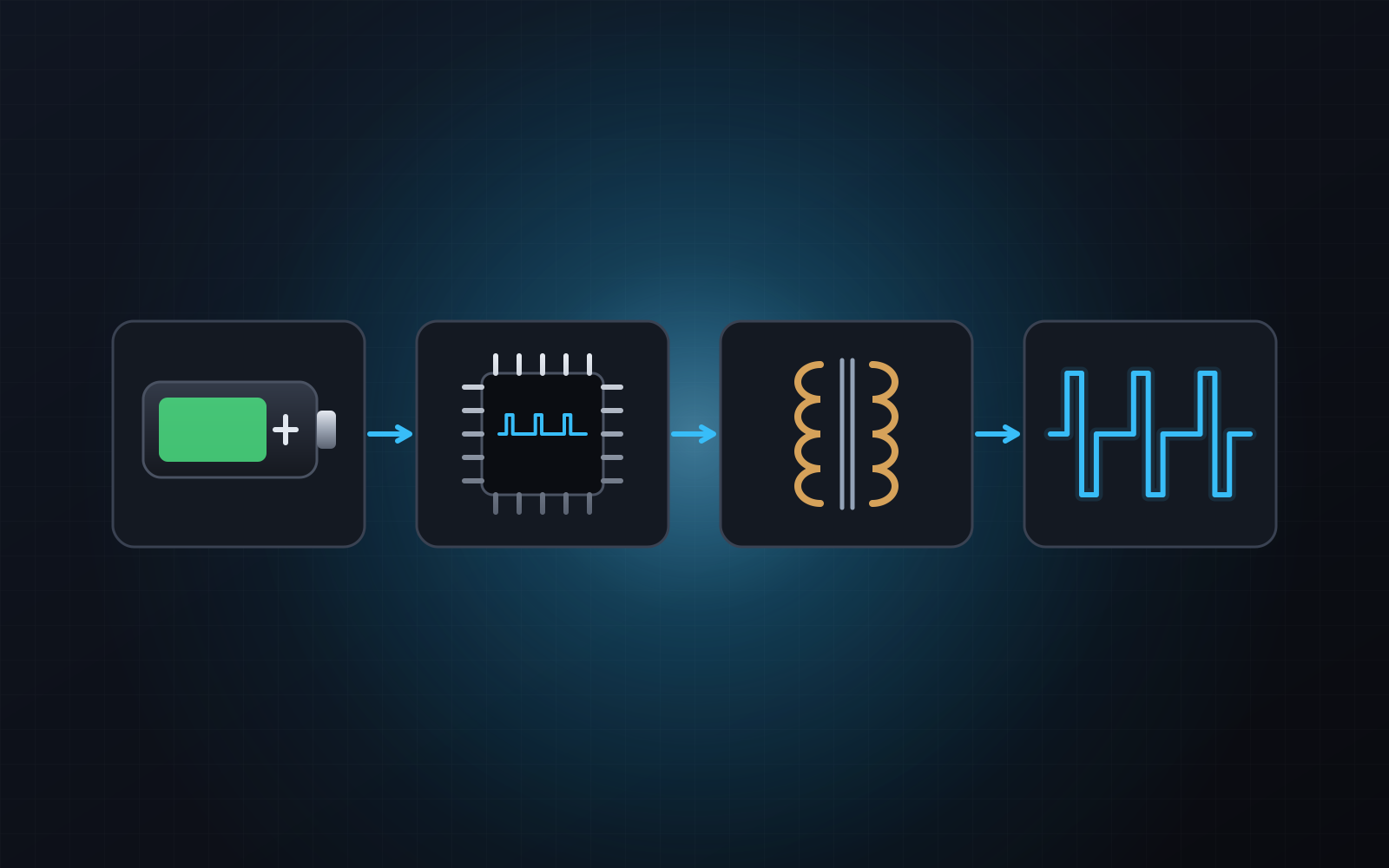
An e-stim unit takes a few volts from a battery and turns them into short, carefully limited pulses at a much higher voltage. This article walks through each stage so you know what the box is doing. It isn't a build guide.
Why it needs a higher voltage#
Dry skin is a poor conductor. A 9 V battery held against it does nothing you can feel, because the skin's resistance lets almost no current through. To push a useful current across the skin, the unit has to raise the voltage to tens of volts, sometimes more.
What you feel is the current, not the voltage. The amounts involved are small: thousandths of an amp (milliamps), delivered in pulses that last a fraction of a thousandth of a second.
The four stages#
1. The power source#
Usually a 9 V battery, a few AA cells or a built-in rechargeable cell. Running from a battery keeps the whole unit separate from the mains, which is the single most important safety feature it has. See Batteries, Chargers and Mains Power.
2. The pulse generator#
This is the brain. In older and simpler units it's a timer circuit. In modern ones it's a small microcontroller, a computer on a chip. It decides:
- how often a pulse is sent (the pulse rate or frequency)
- how long each pulse lasts (the pulse width)
- how those change over time (the mode or pattern)
Pulses, Frequency and Waveforms covers what those do.
3. The output stage#
This is the muscle. It takes the timing signal and produces the actual pulse. There are two common ways of doing it:
- A small transformer. The unit switches battery current through one winding, and a higher-voltage pulse appears on the other. The transformer also separates the output from the rest of the circuit.
- A step-up converter and electronic switches. The unit charges a capacitor to a higher voltage, then switches it to the output in one direction and then the other.
Either way, the design limits how much energy each pulse can carry. That limit is what makes a properly designed unit different from a random high-voltage circuit.
4. The level control#
The dial or buttons set how strong each pulse is. On most units each channel has its own.
Channels#
A channel is one output with two connections. A two-channel unit can drive two pairs of electrodes at different levels.
On some units the channels are fully separate from each other inside, so current only ever flows between the two electrodes of the same channel. On others they share a connection, and some current can find its way between an electrode on channel A and one on channel B. You usually can't tell from the outside, which is one more reason to keep every electrode below the waist. See Where Electrodes Can and Can't Go.
You are part of the circuit#
The unit can't know in advance what it's connected to. Skin resistance changes with moisture, pressure, electrode size and gel, and it changes during a session too.
Units deal with this in different ways. Some hold the current steady and let the voltage rise as needed. Others hold the voltage and let the current vary. This is why the same number on the display can feel different from one day to the next, and why a pad that's starting to peel can suddenly sting: the same current is being squeezed through a smaller patch of skin. Contact Area and Current Density explains that effect.
Built-in protections#
Better units include some or all of these:
- Start at zero: the output won't come on unless the level is at its minimum.
- Soft start: the level ramps up gently after a mode change.
- Open-circuit detection: the unit drops the output to zero if an electrode comes off, so it can't jump when contact returns.
- A session timer that switches off after a set time.
- Balanced pulses, with equal current in each direction, which is kinder to skin and to metal electrodes.
None of these replaces sensible use, but they're worth having. They're also a good list of questions to ask about any unit you're thinking of buying.