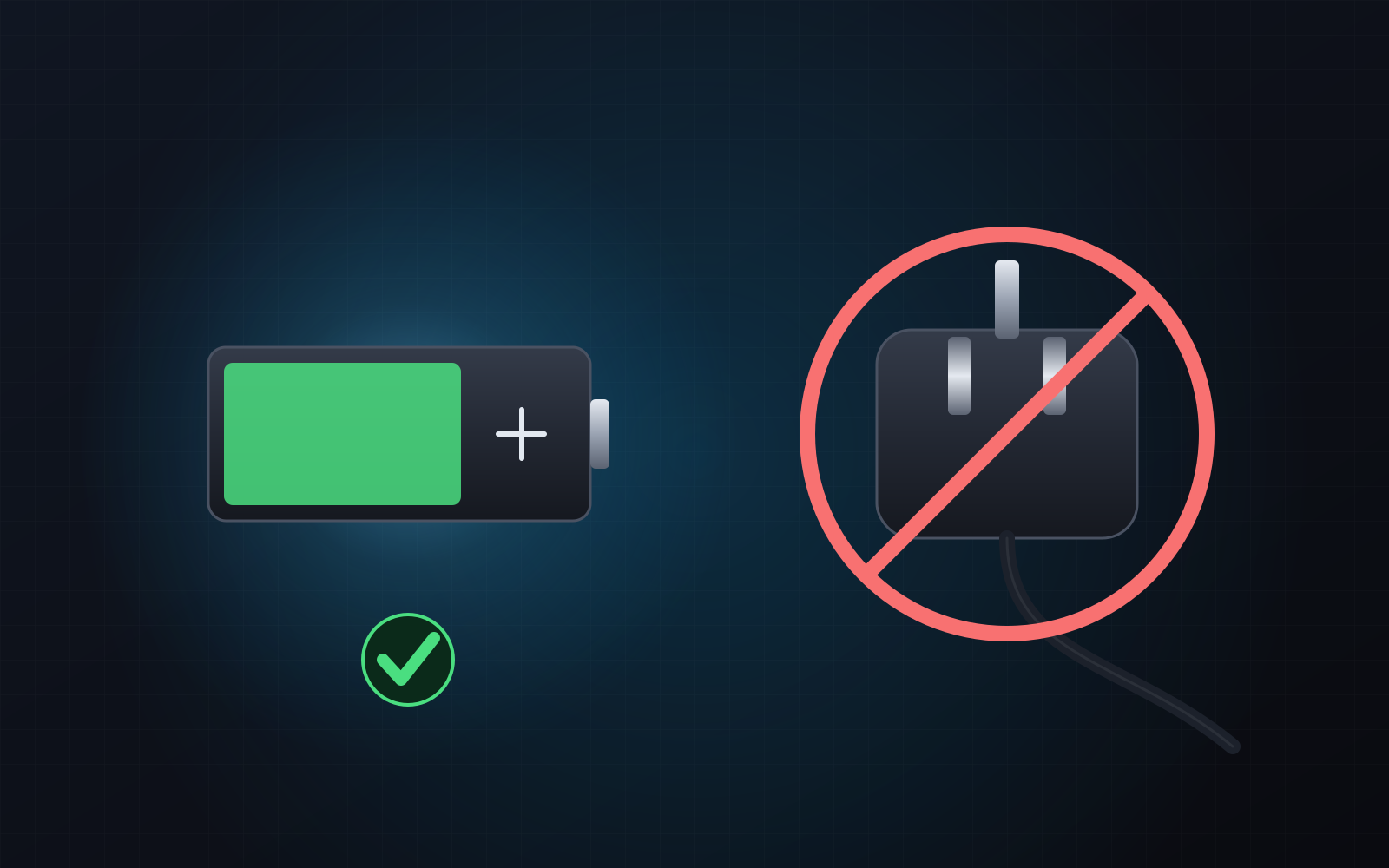
Most e-stim units run on batteries, and that's a safety decision as much as a convenience. This article explains why, and where mains electricity can sneak back in.
Why batteries are safer#
UK mains is 230 V and can deliver far more current than the body can survive. An e-stim unit works by connecting you to its output with good, low-resistance electrodes, exactly the conditions under which a mains fault would do the most harm.
A battery-powered unit has no connection to the mains at all. Whatever goes wrong inside it, the most it can deliver is what its own small battery and output stage can produce.
What "isolation" means#
An isolated output has no electrical connection to the mains or to earth. The current can only go out of one electrode and back into the other. It has no reason to go anywhere else.
A battery unit sitting on a table is isolated by its nature. The isolation is lost the moment the unit is connected to something else that isn't.
Where the mains gets back in#
Charging#
A rechargeable unit that's plugged into a charger is now connected, through that charger, to the mains. A good charger keeps the two sides apart, but cheap USB chargers are known for poor insulation between the mains side and the low-voltage side.
Many units refuse to run while charging. If yours doesn't, don't use it on charge unless the maker clearly says it's designed for that. Charge it, unplug it, then use it.
Mains adapters#
Some units can run from a plug-in power supply. Only use the supply that came with the unit or one the maker specifies. Medical equipment uses specially built supplies for this reason, and an ordinary adapter of the right voltage isn't the same thing.
Things you connect to the unit#
An audio cable to a mains-powered computer or amplifier, or a USB cable to a PC, can link the unit to mains earth unless the unit isolates that input. Use a battery-powered phone or player that isn't on charge, or check that the maker says the input is isolated. See Audio-Driven E-Stim.
Things never to do#
- Never connect anything mains-powered directly to the body, however low its output voltage.
- Never use a bench power supply, a model-railway controller, a doorbell transformer, a battery charger or similar as an e-stim source.
- Never use a home-made mains-powered unit. Getting isolation right takes specific parts, spacing and testing.
- Never use e-stim in a bath or shower.
Looking after batteries#
9 V and AA cells#
- Use good alkaline cells, or rechargeables if the manual allows them.
- Replace them when the unit shows low battery or the output starts to feel weak or uneven. A fading battery can make the output unpredictable.
- Take them out if the unit won't be used for a month or more. Leaking cells destroy battery contacts and circuit boards.
Built-in rechargeable cells#
- Charge with the supplied lead and a good-quality charger.
- Don't leave a unit charging unattended on soft furnishings.
- Stop using it, and don't charge it, if the case bulges, it gets hot, or it smells odd. A swollen lithium cell is a fire risk and needs replacing or proper disposal.
- For storage, leave it part-charged and top it up every few months.
Disposal#
Take old batteries to a battery recycling point. Most supermarkets have one. Don't put them in the household bin.
The short version#
Run on batteries. Unplug the charger first. Be careful what else you plug in. And keep the unit dry.