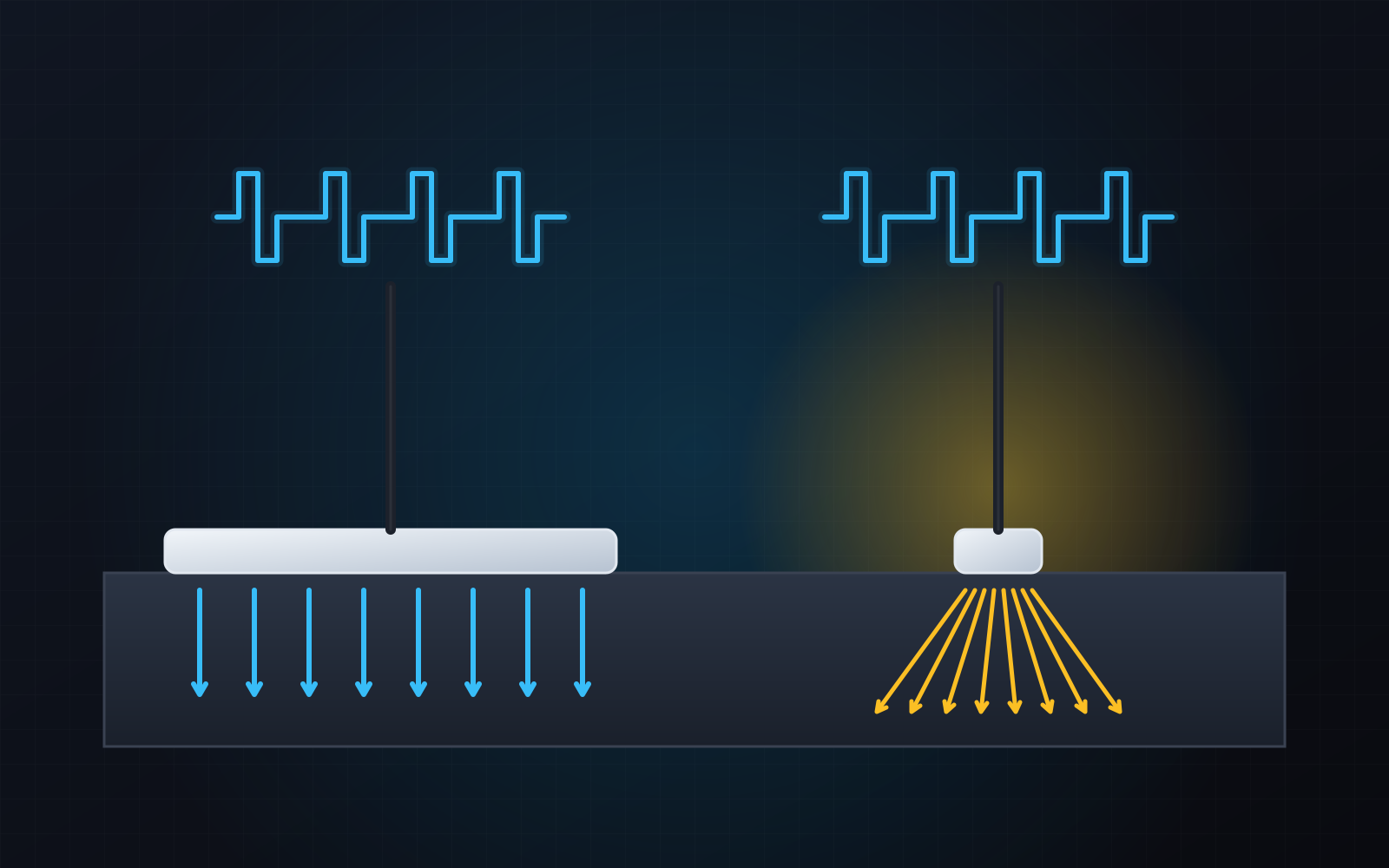
If you only learn one piece of theory about e-stim, make it this one. It explains why some electrodes sting, why pads start to bite as they age, and how nearly all e-stim burns happen.
The idea#
Current density is how much current passes through each bit of skin. It's the current divided by the area it flows through.
Think of a garden hose. The same flow of water through a wide-open end is a gentle stream. Put your thumb over most of the opening and it becomes a sharp jet. Nothing about the flow changed, only the size of the hole.
Electrodes work the same way:
- Large contact area: the current is spread out. The sensation is smooth and the skin stays cool.
- Small contact area: the same current is crowded into a little patch. It feels sharp and prickly, and the skin there heats up.
What you'll notice in practice#
The smaller electrode always feels stronger#
The same current flows through both electrodes of a pair. If one is half the size of the other, it carries twice the current density, and that's the one you'll feel most. It's also where a burn would start.
You can use this on purpose: pair a small electrode with a much larger one, and the large one almost disappears.
A peeling pad stings#
A pad that has lifted at one edge is now a smaller pad. As more of it lifts, the remaining patch takes all the current. That's the hot, prickly spot that tells you to stop and re-seat it.
Dried gel does the same thing#
Gel fills the tiny gaps between an electrode and the skin. As it dries, contact shrinks to scattered points, each one carrying far more than its share.
Edges and corners bite#
Current crowds toward the edges of an electrode, especially a metal one. Sharp corners, narrow strips and points concentrate it further. Rounded shapes and slightly resistive materials such as conductive rubber even it out.
How burns happen#
Skin is the highest-resistance part of the circuit, so it's where most of the heat is produced. Spread over a large pad, that heat is tiny and blood flow carries it away. Concentrated into a few square millimetres, it isn't.
Things that raise the risk:
- small, thin or pointed electrodes
- poor contact: dry gel, old pads, hair under a pad, lifted edges
- high levels, long pulse widths and fast pulse rates, all of which add energy
- long sessions without checking the skin
- one-way (unbalanced) current, which adds chemical irritation on top of heat
Burns from e-stim often don't hurt much at the time, particularly at high pulse rates where the sensation is a smooth buzz. Look as well as feel.
Keeping current density down#
- Use the largest electrode that suits the place.
- Get full, even contact. Clean skin, pads pressed down all over, plenty of gel on anything that isn't self-adhesive.
- Re-apply gel as it dries.
- Replace worn pads. If it won't stay stuck, it's finished.
- Turn the level down for small electrodes. A setting that's fine on a large pad may be far too much on a small contact.
- Check the skin at every break. Even pinkness under the whole pad is common and fades. Small red dots, a red edge line or a pale blister mean the current was concentrating there.
A note on numbers#
Published safety limits for medical stimulators are written in terms of current and power per square centimetre of electrode. You can't easily measure those at home, and you don't need to. The practical version is simply: bigger, wetter and better-stuck is gentler, and the smaller the contact, the lower the level.
See also Electrode Types and Conductive Gel and Lubricant.