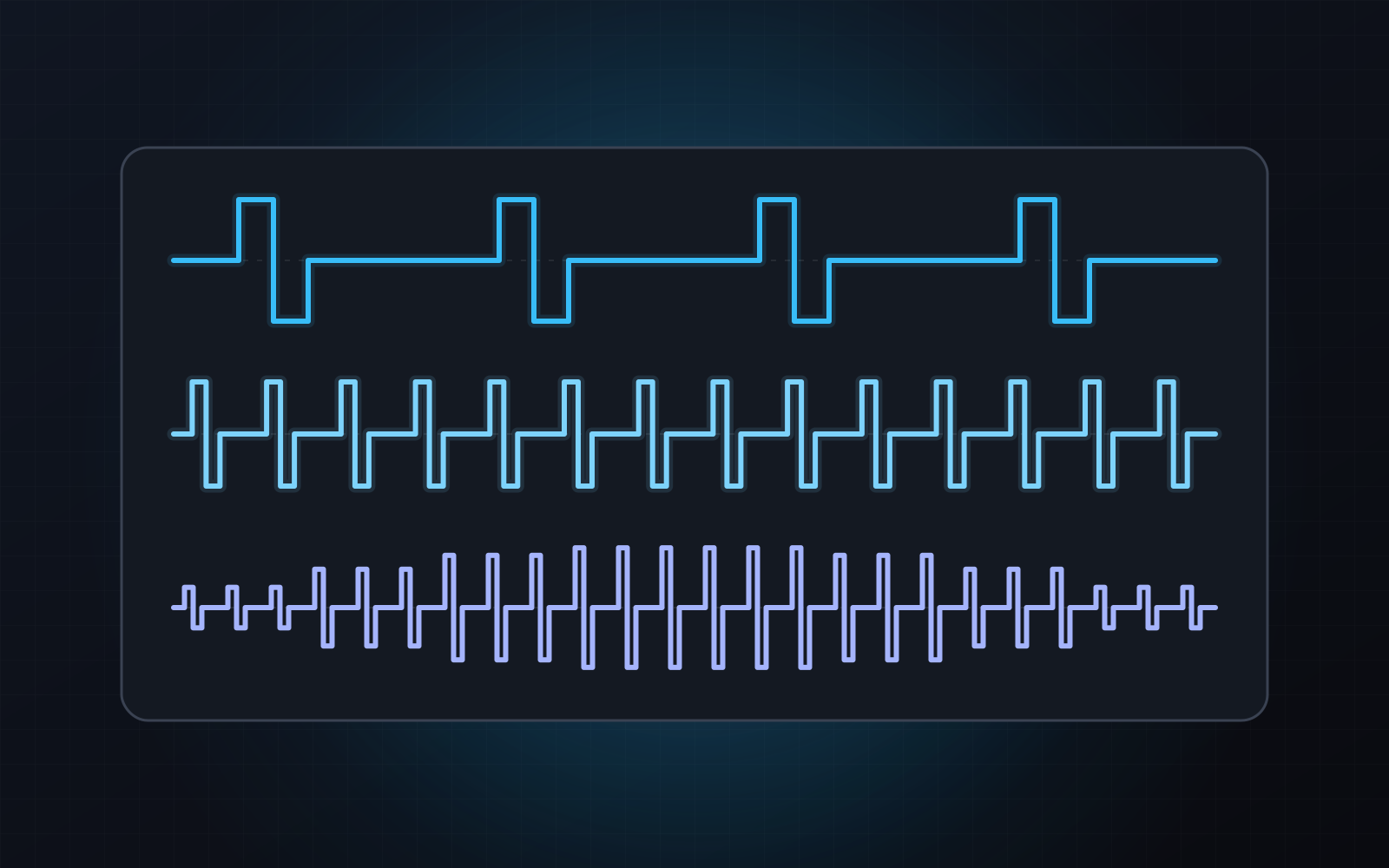
An e-stim unit doesn't send a steady flow of electricity. It sends a stream of very short pulses with gaps between them. Nearly every control on the unit changes something about those pulses. Once you know the four or five things that can change, any unit's settings make sense.
Level (intensity)#
How strong each pulse is. Makers call it level, intensity, power or amplitude, and it's usually shown as a number with no unit.
More level reaches more nerve fibres, and deeper ones. A little gives a surface tingle. More brings in the nerves that drive muscle.
The numbers aren't comparable between units, or even between sessions on the same unit, because what you feel also depends on the electrodes and your skin on the day.
Pulse rate (frequency)#
How many pulses are sent each second, measured in hertz (Hz). Most units cover somewhere between 1 and 150 Hz or so, and some go higher.
- Low rates, up to about 10 Hz: you feel each pulse as a separate tap or thump, and muscles twitch once per pulse.
- Middle rates, around 20 to 50 Hz: the taps run together into a flutter, and muscles start to hold a steady contraction.
- High rates, 80 Hz and above: a smooth buzz or tingle.
Pulse width#
How long each pulse lasts. It's measured in microseconds (µs), millionths of a second. Typical values run from about 50 to 400 µs.
Longer pulses deliver more charge each, so they feel stronger and deeper at the same level setting. Short pulses feel lighter and more "on the surface". If your unit lets you change pulse width, widening it is often a smoother way to get more sensation than turning up the level.
Pulse shape#
Each pulse can push current one way only, or one way and then back.
- Monophasic pulses always go in the same direction. Over time that moves charge steadily one way through the skin.
- Biphasic pulses go one way and then the other. If the two halves carry equal charge (a "balanced" or "symmetrical" pulse), the net flow is zero.
Balanced biphasic pulses are the usual choice in modern units, for good reasons. A steady one-way flow drives chemical reactions where the electrode meets the body, which can irritate or burn the skin and eat away at metal electrodes. Balanced pulses largely avoid that.
With an unbalanced pulse the two electrodes feel different, and one is noticeably stronger than the other. Some units let you swap which is which.
Patterns and modulation#
Nerves adapt. Send them exactly the same pulses for a few minutes and the sensation fades. So most units vary something over time, and that's what the modes are:
- Continuous: steady pulses. Useful for learning, quick to fade.
- Burst: groups of pulses with gaps between them.
- Wave or ramp: the level rises and falls smoothly.
- Rate or width sweep: the pulse rate or width drifts up and down while the level stays put.
- Random: one or more settings change unpredictably.
- Alternating: two channels take turns.
Because of adaptation, changing mode usually does more than adding power. It's also safer.
How they add up#
Level, rate and width all push the total amount of electricity up. A setting that's comfortable at a slow rate with short pulses can be far too much at a fast rate with long ones.
So whenever you change the rate, the width or the mode, turn the level down first and bring it back up. Many units do this for you. Don't rely on it.
Higher rates and longer pulses also put more heating into the skin under the electrode, which matters most with small electrodes. See Contact Area and Current Density.