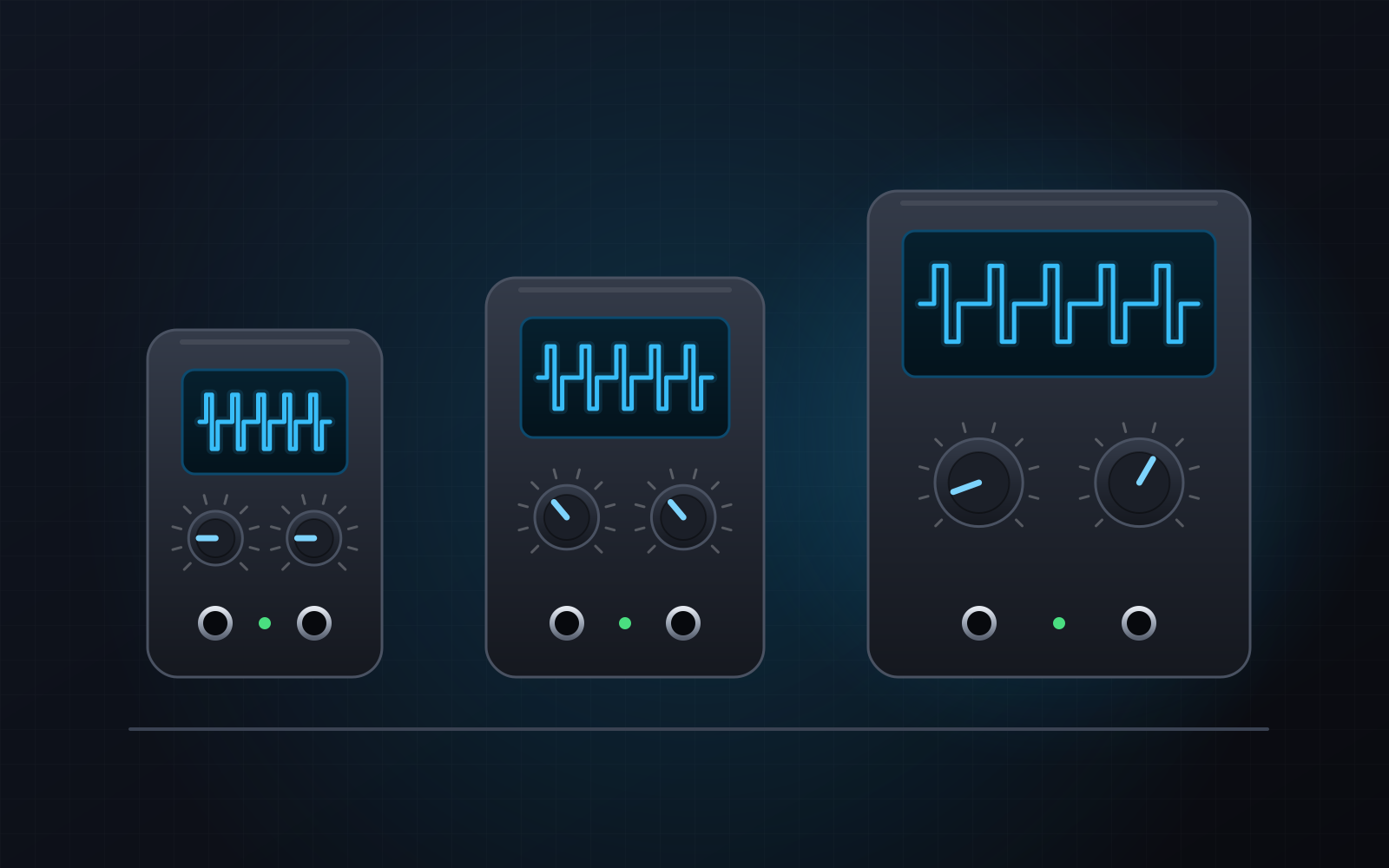
Three kinds of unit turn up whenever people talk about e-stim. Inside they're close relatives: each makes short electrical pulses and sends them to the body through electrodes. What differs is what they were designed to do and how much control they give you.
TENS units#
TENS stands for transcutaneous electrical nerve stimulation ("transcutaneous" just means through the skin). These are the small units sold for pain relief, often in chemists.
- Aimed at: sensory nerves. The goal is a strong but comfortable tingle, not muscle movement.
- Typical settings: pulse rates from about 1 to 150 pulses a second, and very short pulses.
- Controls: usually a level control for each channel and a handful of preset programmes.
- Good points: cheap, easy to find, and built to medical-device rules.
- Limits: few modes, coarse level steps on some models, and programmes designed for pain relief, not variety.
EMS units#
EMS stands for electrical muscle stimulation. You'll also see NMES (neuromuscular electrical stimulation), which means the same thing.
- Aimed at: the nerves that drive muscles, to make them contract.
- Typical settings: similar pulse rates to TENS, often with longer pulses, and a work-and-rest cycle that ramps up, holds, and lets go.
- Good points: strong, rhythmic contractions.
- Limits: the programmes are built for exercise and rehabilitation, so there's little fine control.
Many inexpensive units are sold as TENS/EMS combos. Often the hardware is the same and only the programme changes.
Purpose-made e-stim units#
These are made for recreational use. They're what most people mean by an e-stim "power box".
- More control: fine level adjustment, and often separate control of pulse rate, pulse length and pattern.
- More patterns: waves, ramps, random modes and combinations that change over time, because steady pulses fade into the background quickly.
- Extra inputs: some respond to sound through a microphone or an audio socket (see Audio-Driven E-Stim), and some are controlled from a phone app.
- Connectors and accessories designed for a wider range of electrodes than sticky pads.
- Cost: from a little more than a TENS unit to several hundred pounds.
At a glance#
| TENS | EMS | Purpose-made e-stim | |
|---|---|---|---|
| Designed for | Pain relief | Muscle contraction | Sensation and variety |
| Channels | Usually 2 | 2 to 4 | Usually 2 |
| Fine control | Limited | Limited | Good |
| Patterns | A few presets | Work/rest programmes | Many |
| Sold as | Medical device | Medical or fitness device | Adult product |
Which should a beginner use?#
A TENS unit is a perfectly sensible way to find out whether you like the sensation at all, as long as it's a properly made one from a known brand. If you get on with it, a purpose-made unit is the usual next step.
Whichever you choose, the same safety rules apply. A TENS unit is not "safer" in the wrong place: its own instructions will tell you never to use it across the chest, on the head or on the front of the neck.
What is not an e-stim unit#
- Anything that plugs into the mains without proper isolation. See Batteries, Chargers and Mains Power.
- Home-made circuits, unless you have the training to design and test them properly.
- Novelty shock toys, electric fly swatters, fence energisers, ignition coils and the like. They're not built to limit what reaches the body.
- Violet wands. They're a different technology that works with high-voltage sparks over the skin, with their own separate rules.