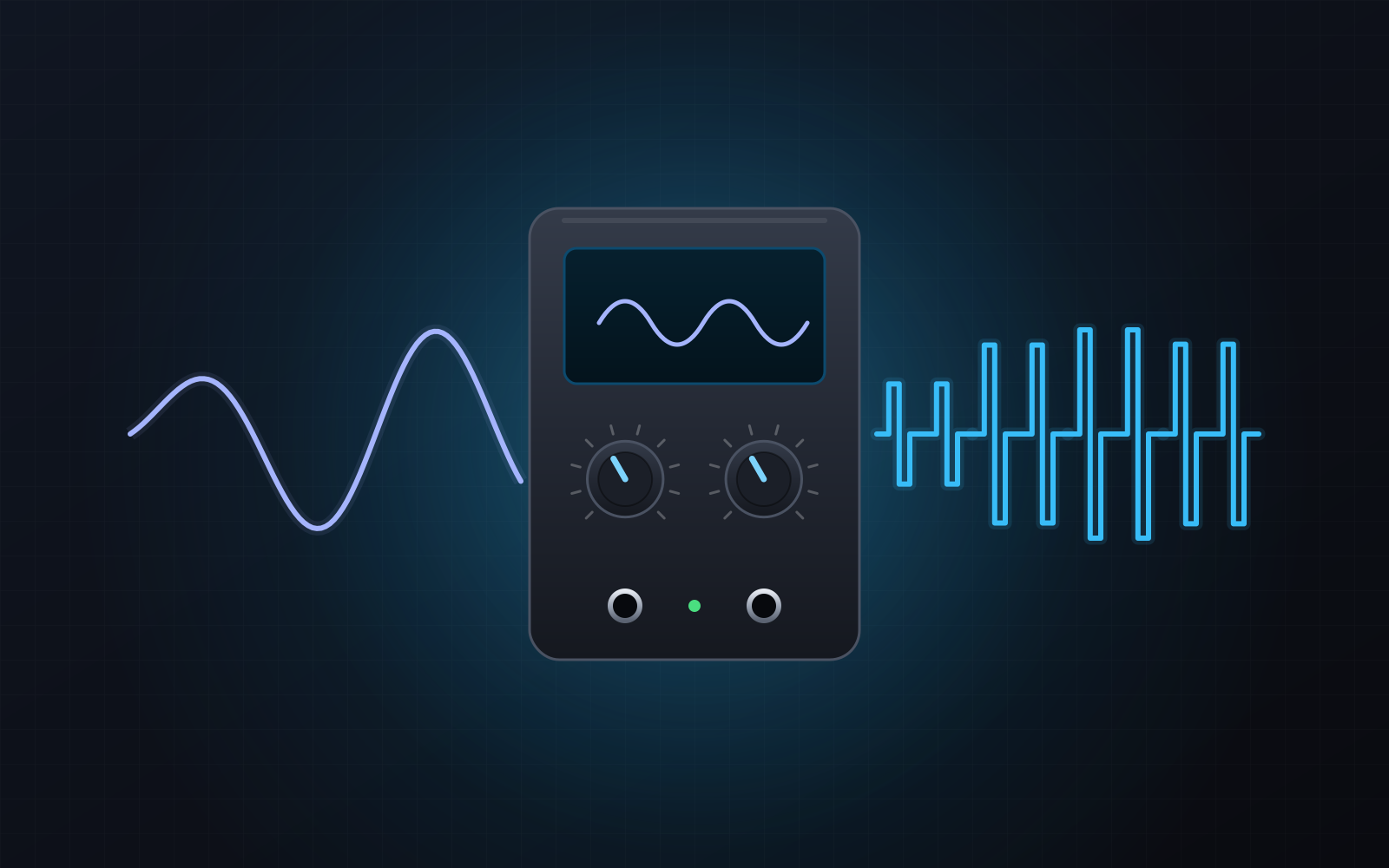
Many purpose-made units can respond to sound: music, a voice, or audio files made specially for e-stim. It opens up far more variety than built-in modes. It also adds two new ways for things to go wrong, both easy to avoid.
Two different things called "audio"#
Sound-triggered#
The unit listens, through a built-in microphone or an audio socket, and uses the loudness of the sound to control its own pulses. Louder sound means a stronger output.
The pulses themselves are still made by the unit, so its normal limits apply. This is the gentler way in.
Sound-driven#
The audio signal itself becomes the output. The unit, or a separate box, takes the sound waveform, steps it up and sends it to the electrodes.
Here the sound's volume sets the strength, and its pitch sets the feel, in the same way pulse rate does in Pulses, Frequency and Waveforms. Low tones feel thumpy, and higher tones feel smoother. This approach is often called "stereostim", because a stereo track has two channels, left and right, that drive the unit's two outputs separately.
What audio files are#
Tracks made for e-stim are mostly pure tones whose loudness and pitch are varied over time, sometimes differently on left and right. They aren't music, and ordinary music doesn't work especially well: it has too much going on, with sudden loud peaks.
How a file feels depends heavily on the unit, the electrodes and the volume. The same file can be mild on one setup and fierce on another.
The two safety rules#
1. Keep the mains out#
Plugging an audio cable into your unit joins it to whatever is at the other end. If that's a desktop computer, a mains-powered amplifier, or a phone or laptop on charge, there may now be a path from your electrodes back to the mains or to earth.
So:
- Play audio from a battery-powered device that isn't charging.
- Or use a unit whose maker states that its audio input is isolated.
- A wireless link, where the unit supports one, avoids the cable altogether.
See Batteries, Chargers and Mains Power.
2. Control the volume#
With sound-driven output, anything that makes a noise becomes a pulse. A notification chime, an incoming call, an advert or a loud passage in a file arrives as a jolt.
- Start with the player's volume and the unit's level at zero. Bring the unit's level up first to a low setting, then the volume, slowly.
- Put the phone in do-not-disturb or flight mode.
- Turn off volume-levelling, equaliser and "enhancement" settings, which can change loudness without warning.
- Use files you've played through before at a low level. Don't trust an unfamiliar file at a level you worked out with a different one.
- Keep the unit's own level control in reach. It's your stop.
What not to do#
Never connect electrodes to the speaker or headphone output of an amplifier, sound card, phone or music player, with or without a transformer you've added yourself. Those outputs aren't isolated from their power supply and aren't limited for the body. An amplifier can deliver many times more than any e-stim unit.
Purpose-made stereostim boxes exist, and they contain the parts needed to do this job properly. Building one is a project for someone with the training to design and test the isolation and output limits, not a quick hack.
Is it worth trying?#
If your unit has an audio input, yes, once you're comfortable with its ordinary modes. Start with the microphone or sound-triggered mode, then move on to audio files at a low level.
The same placement rules apply as always. Audio changes how the sensation is shaped, not where it's safe to put it. See E-Stim Safety.