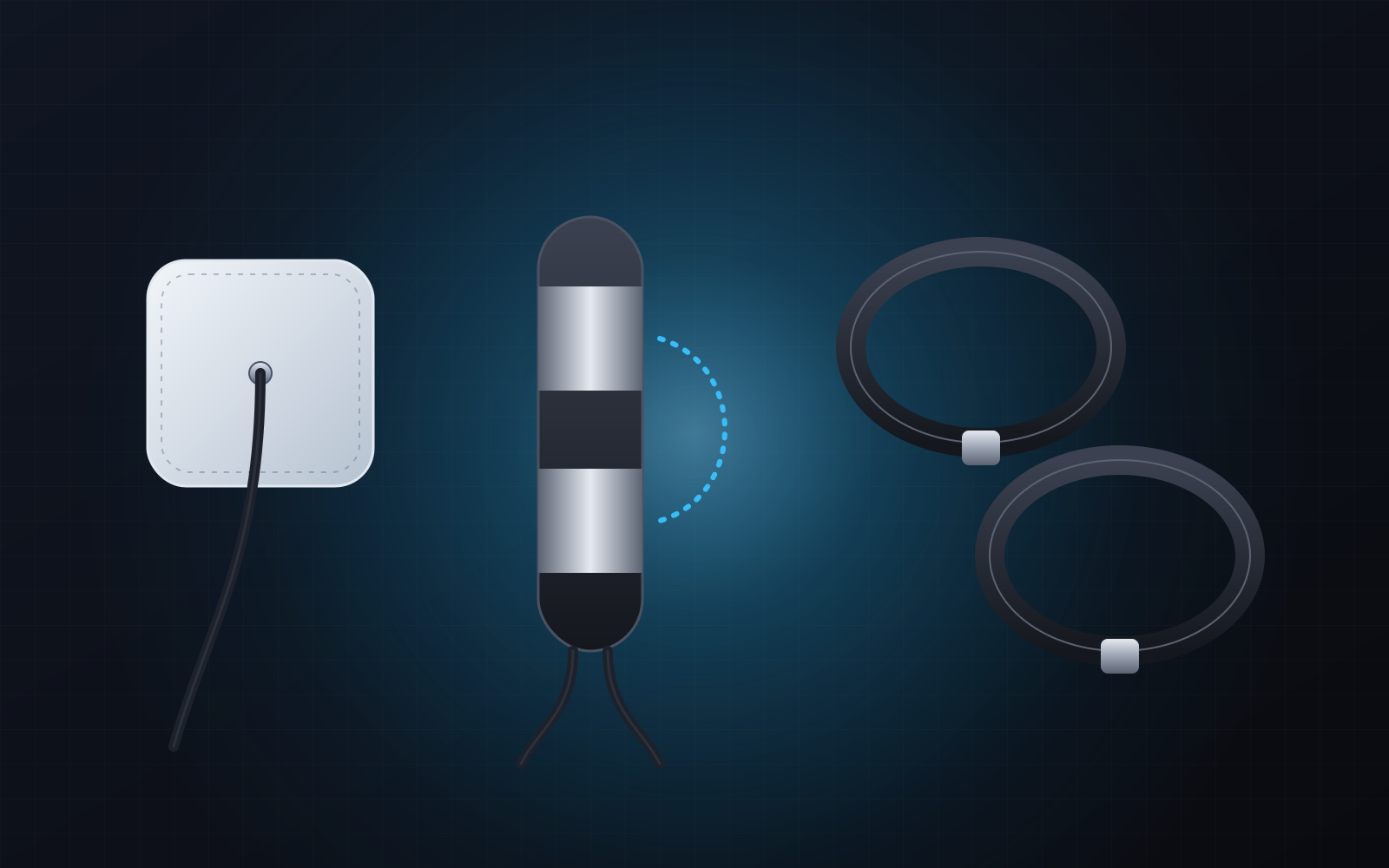
The electrode is where the electricity meets the body, and it shapes the sensation at least as much as the unit does. This article covers the main kinds and the words used to describe them.
Monopolar and bipolar#
These two words describe how many contacts an electrode has. They cause more confusion than anything else in e-stim.
Monopolar#
A monopolar electrode has one contact and one connection. On its own it does nothing, because the circuit isn't complete. You need two of them on the same channel, and the current flows between the two through the body.
A single sticky pad is a monopolar electrode. So is a conductive loop or a single metal plate.
Bipolar#
A bipolar electrode has two separate contacts built into one item, with an insulating gap between them and two connections. It completes the circuit on its own, and the current flows from one contact to the other through the tissue touching both.
Because the two contacts are close together, the sensation is local and the current path is short and predictable.
Which is which?#
Count the connections. One socket or wire means monopolar, and you need a second electrode. Two means bipolar.
Self-adhesive pads#
The familiar TENS pad: a flexible conductive layer with a sticky gel face and a wire or stud.
- Good for: learning, larger muscles, and any flat area of skin.
- Sizes: larger pads feel gentler and smoother. Small pads feel sharper.
- Life: they're consumables. The gel dries out and picks up skin oils, and a pad that no longer sticks properly should be replaced.
- Hygiene: keep them to one person.
Conductive rubber and silicone#
Soft black rubber or silicone loaded with carbon so that it conducts. It's used for loops, bands, flexible pads and sleeves.
- Good for: wrapping around curved parts of the body, where a flat pad won't sit.
- Feel: gentle and even, because the material has some resistance of its own that helps spread the current.
- Needs: conductive gel or water-based lubricant, re-applied as it dries.
- Life: the material slowly loses conductivity with age and use, and eventually feels patchy.
Metal electrodes#
Usually stainless steel or aluminium, sometimes plated brass.
- Good for: strong, crisp sensation and easy cleaning.
- Feel: metal conducts almost perfectly, so it doesn't even out the current the way rubber does. Good, full contact and plenty of gel matter more.
- Watch for: edges and corners, where current concentrates. Some people react to nickel in plated metals or lower-grade steel.
Conductive fabric#
Cloth woven with silver or other conductive thread, made into gloves, socks, sleeves and garments.
- Good for: spreading current over a large, awkward area such as a foot or hand.
- Needs: to be damp to conduct well. Water or a conductive spray is usual.
Conductive gloves are worn by the person applying the sensation, which puts that person in the circuit too. The same placement rules apply to them.
Insertable electrodes#
Electrodes made for internal use come in both bipolar and monopolar forms, in metal, rubber and rigid plastic with metal bands. Internal tissue conducts much better than skin, so they need far lower levels. Buy only purpose-made ones from reputable makers and follow their instructions and cleaning advice.
Choosing a first set#
- Start with a pack of medium or large self-adhesive pads.
- Add a simple bipolar electrode or a pair of conductive rubber loops once you know your unit.
- Check the connector fits your leads before you buy. See Cables and Connectors.
Whatever you use, the size of the contact matters more than almost anything else. That's the subject of Contact Area and Current Density.