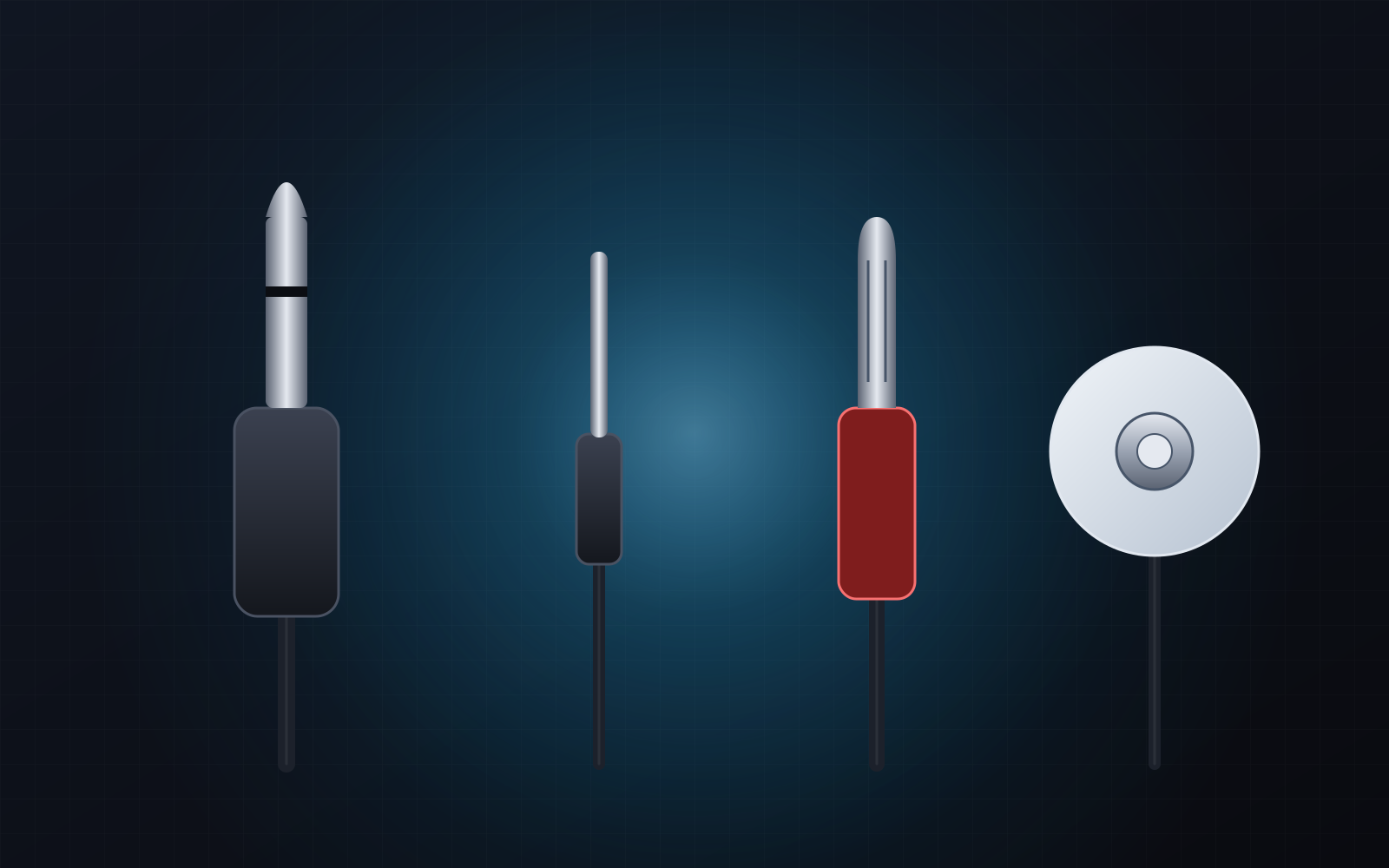
Leads are the least exciting part of an e-stim kit and the part most likely to cause trouble. This article covers the connectors you'll meet, how to match them up, and how to make leads last.
There's no single standard. Always check what your own unit and electrodes use before buying.
A lead has two ends#
- The unit end plugs into the power unit. One plug per channel.
- The electrode end splits into two wires, one for each side of the channel.
The two ends are chosen separately, so the same unit can be used with different electrode connectors by changing the lead.
At the unit end#
3.5 mm jack#
The same size as a wired headphone plug. It's common on purpose-made e-stim units and on some TENS units. One jack carries both sides of one channel.
2.5 mm jack#
A smaller version, found on many TENS and EMS units. It looks similar at a glance, so measure or check the manual. Some TENS units use a slightly different shrouded "safety" plug that only fits its own kind of socket.
Proprietary plugs#
Some makers use their own connector. Leads then have to come from that maker or be made to fit.
At the electrode end#
2 mm pins#
Thin metal pins, about 2 mm across. This is the usual connector on TENS pads with a short wire "pigtail", and on many smaller accessories. The pin pushes into a small sleeve on the pad's wire.
4 mm banana plugs#
A larger, sprung plug about 4 mm across, borrowed from test equipment. Many purpose-made electrodes have 4 mm sockets. They grip firmly and carry the connection reliably.
Snaps#
A press-stud, like the fastener on a jacket. Some pads have a metal stud on the back and the lead clips onto it. Snap pads are quick to change but stand a little prouder of the skin.
Adapters#
Because 2 mm and 4 mm are both common, adapters between them are everywhere:
- 2 mm pin to 4 mm banana, to use a TENS-style lead with a 4 mm electrode
- 4 mm to 2 mm, for the opposite case
- pin to snap, for snap pads
Adapters are handy, but each one is another joint to work loose. If you use one combination a lot, buy a lead that fits directly.
Colours and polarity#
The two wires are usually red and black. With balanced (biphasic) pulses it makes no difference which electrode gets which. With unbalanced pulses the two feel different, and swapping the wires swaps the feel. See Pulses, Frequency and Waveforms.
Splitters#
A splitter lead turns one channel into two or more pairs of connections. All the electrodes on it share the same output and the same level, and the current divides between them according to their contact. It doesn't give you an extra independent channel.
Why leads fail#
The fine wire inside breaks where it's bent most: right at the plug and at the pin. The insulation often looks perfect.
A broken wire makes the output cut out and return as the cable moves, which feels like sudden jolts. It's the most common cause of "my unit is doing something odd".
To check a lead, set the unit to a low, steady level with pads on your thigh, then gently flex the lead along its length and at each end. If the sensation cuts in and out, replace the lead. If you have a multimeter, the continuity setting tells you the same thing without wearing it.
Making leads last#
- Pull on the plug, never the wire.
- Coil them loosely. Don't wrap them tightly around the unit.
- Keep gel off the pins and plugs, and wipe them if it gets there.
- Don't leave leads plugged in when the unit is in a bag or drawer, where the plug can get levered sideways.
- Keep a spare set. They cost little and they always fail at the wrong moment.