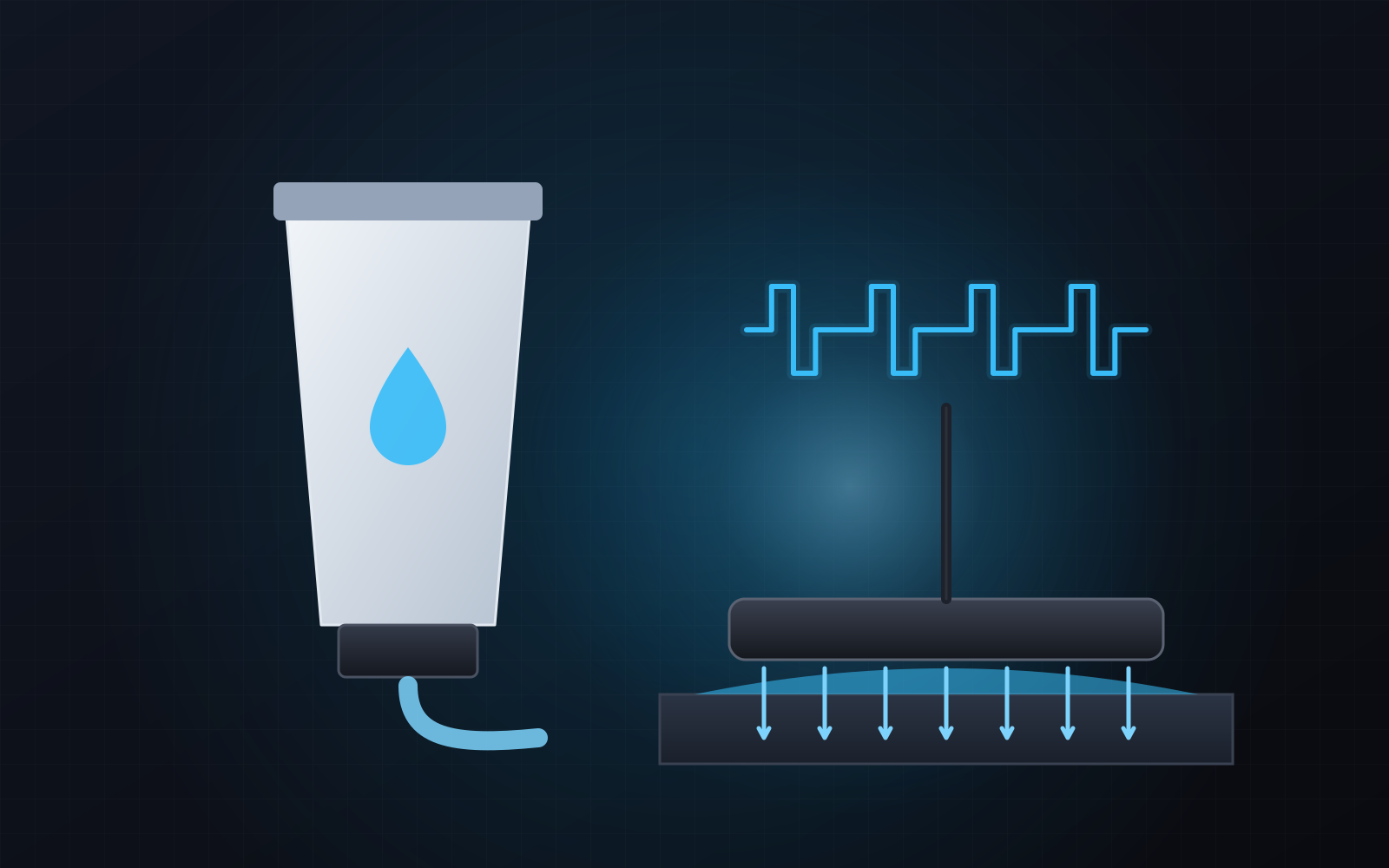
Gel is the cheapest part of an e-stim kit and makes one of the biggest differences. It turns a patchy, prickly contact into a smooth one.
What gel does#
No electrode sits perfectly flat against skin. Under a magnifying glass there are ridges, pores, hairs and air gaps, and dry skin itself conducts poorly. Without something to fill the gaps, the current crosses at a scatter of small points, each carrying far more than its share. That's what a prickly, stinging contact is.
A conductive gel fills those gaps and wets the top layer of the skin, so the whole face of the electrode carries current evenly. See Contact Area and Current Density for why that matters.
When you need it#
| Electrode | Gel needed? |
|---|---|
| Self-adhesive pads | No. The sticky face is the gel. |
| Conductive rubber or silicone | Yes |
| Metal | Yes |
| Conductive fabric | Dampen with water or a conductive spray |
| Insertable electrodes | Yes, as the maker directs |
Don't add gel to a self-adhesive pad. It stops the pad sticking and doesn't improve it.
What works#
Electrode gel#
Sold for TENS, ultrasound and ECG use, and by e-stim makers. It's water-based, contains salts to help it conduct, and is made to stay put on skin. This is the first choice.
Water-based lubricant#
Plain water-based personal lubricant conducts well enough for most purposes and is a common substitute, especially with insertable electrodes. Thicker ones last longer before drying.
Plain water#
Fine for dampening fabric electrodes. On rubber or metal it runs off and dries too quickly to rely on.
What doesn't work#
- Silicone-based lubricant. Silicone is an insulator. It blocks the current, and what gets through does so in unpredictable patches.
- Oils, petroleum jelly, massage oil and body lotion. All insulators, for the same reason. Wash them off the skin before a session.
- Numbing or warming products. Anything that dulls or changes sensation hides the feedback you rely on to stay safe.
- Home-made salt pastes. Strong salt solutions can irritate skin and corrode metal electrodes. Buy the proper thing; it's inexpensive.
How much to use#
A thin, even layer over the whole contact face. It should look wet all over without dripping. Too little leaves dry spots. A huge excess can bridge between two nearby contacts and let the current skip past the skin.
That last point matters with bipolar electrodes. Wipe gel out of the insulating gap between the two contacts.
When it dries out#
Water-based gels dry during a session, faster in a warm room. The signs:
- the sensation fades, so you're tempted to turn up
- then it turns sharp or prickly in spots
- the electrode starts to drag on the skin
When that happens, turn the level down to zero, add more gel, and bring the level back up from low. Don't simply turn up to compensate. A level that suits a dried-out contact will be too much the moment it's wet again.
A drop of water will revive gel that's started to dry, for a while.
Skin reactions#
Some gels and lubricants contain preservatives, fragrances or glycerine that irritate some people. If your skin is red or itchy where the gel was, not just under the electrode, try a different product, and choose one sold as hypoallergenic.
Cleaning up#
Wipe gel off electrodes after every session, before it dries to a crust. Dried gel is a poor conductor, and salts left on metal encourage tarnish. Keep it off plugs, pins and sockets. Cleaning and Care covers the rest.