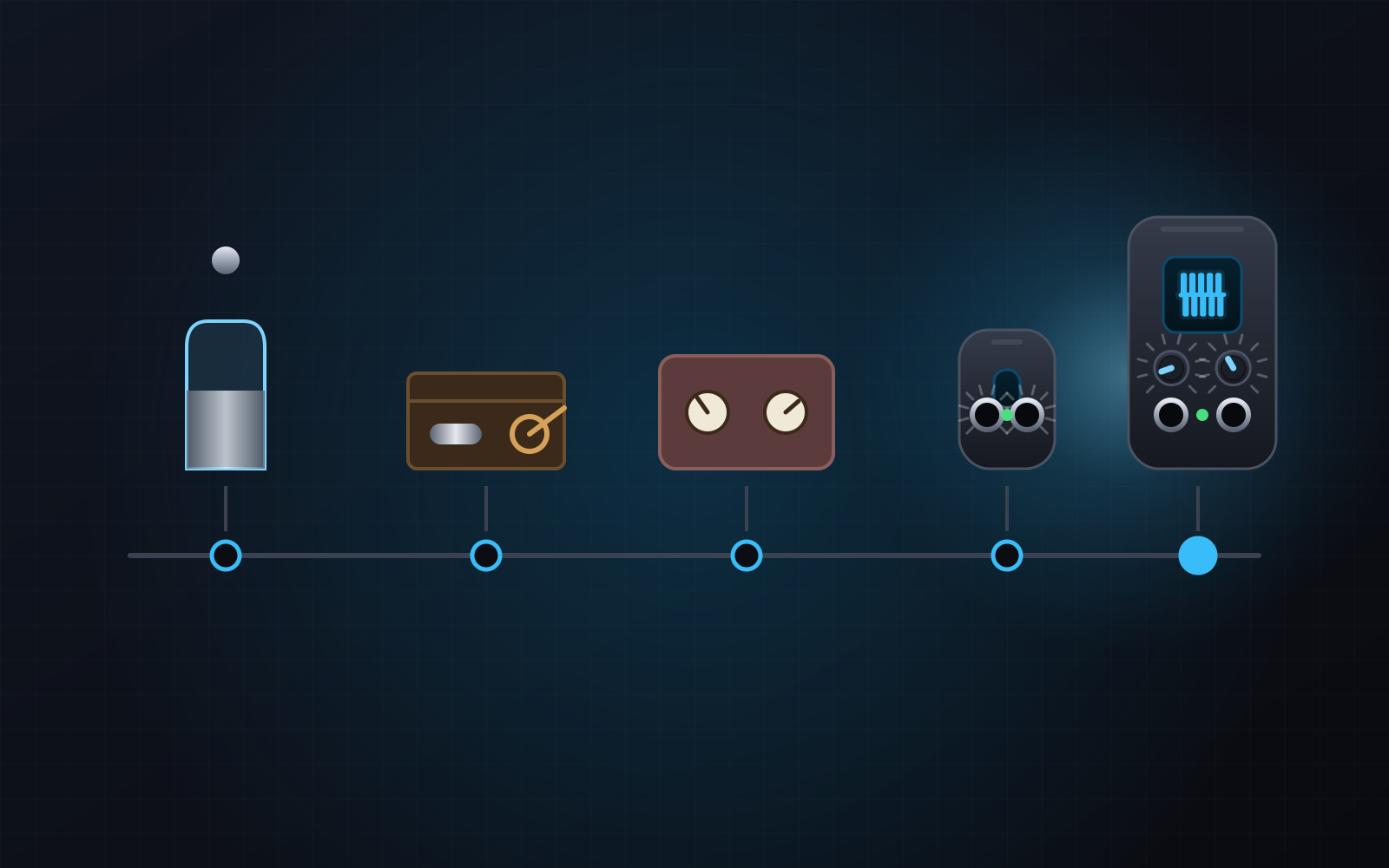
People have been passing electricity through themselves on purpose for nearly three hundred years, for medicine, for curiosity and for fun. Modern e-stim sits at the end of that long line.
Sparks in the parlour#
By the 1740s, friction machines and the newly invented Leyden jar (an early way of storing a charge) had made electric shocks a fashionable entertainment. Demonstrators passed a jolt along lines of people holding hands, and "electrical kisses" were a party trick.
Later in the century Luigi Galvani showed that electricity made a dissected frog's leg twitch, and the link between electricity, nerves and muscle became a serious subject of study.
Medical batteries and electric belts#
In the nineteenth century, electricity was sold to the public as a treatment for almost anything. Hand-cranked magneto machines and "medical batteries" came in handsome wooden boxes with metal handles and pads. In 1855 the French doctor Guillaume Duchenne published detailed work on using electricity to make individual muscles contract, the root of what's now called EMS.
Alongside the real research came a great deal of quackery. Electric belts were advertised, among other things, as cures for male "weakness". Most did little or nothing, and the claims were eventually discredited.
Violet rays belong to this era too. They're a different technology, using high-voltage sparks over the skin instead of current through it.
The Relax-A-Cizor#
From the 1950s an American company sold the Relax-A-Cizor, a muscle stimulator promoted for slimming without exercise. Hundreds of thousands were sold. It was eventually banned in the United States after the authorities found it could cause harm.
It's remembered in e-stim circles because it was also one of the first widely owned devices that people adapted for erotic use.
TENS arrives#
Modern TENS is usually credited to the American neurosurgeon C. Norman Shealy, who worked on electrical pain relief in the late 1960s. The first TENS unit that a patient could wear was patented in the United States in 1974.
Small, battery-powered and relatively safe, TENS units were soon being used for more than pain relief. Through the 1970s hobbyists also experimented with sound-driven stimulation using hi-fi equipment and home-made electrodes, the origin of what's now called stereostim.
Purpose-made units#
The first units designed and sold for erotic e-stim appeared in the 1980s. Accounts of the period name devices such as the Titillator and the Pleasure Box, which later became the PES Power Box, as the earliest. They were analogue designs with a few dials.
From there the pattern followed the rest of consumer electronics:
- Microcontrollers replaced timer circuits, bringing many more modes, displays and finer level control.
- Audio inputs became a common feature.
- Specialist electrodes in conductive rubber and metal replaced adapted TENS pads and home-made parts.
- Rechargeable batteries, phone apps and wireless control arrived in more recent units.
What hasn't changed#
The basic method is the same as in Duchenne's day: two contacts, and a small, controlled current between them. What has improved is the control, the consistency and the understanding of the risks.
The cautionary tales haven't changed either. Devices sold on big promises, home-made equipment connected to the mains, and current passed through the chest account for much of the harm in this history. The rules in E-Stim Safety are the lessons learned from it.
A note on sources#
The early history of recreational e-stim is poorly documented, and much of what's repeated online comes from enthusiasts' recollections. Dates and device names from the 1970s and 1980s in particular should be read as the commonly told version, not settled fact. If you can correct or add to any of it, please get in touch.